
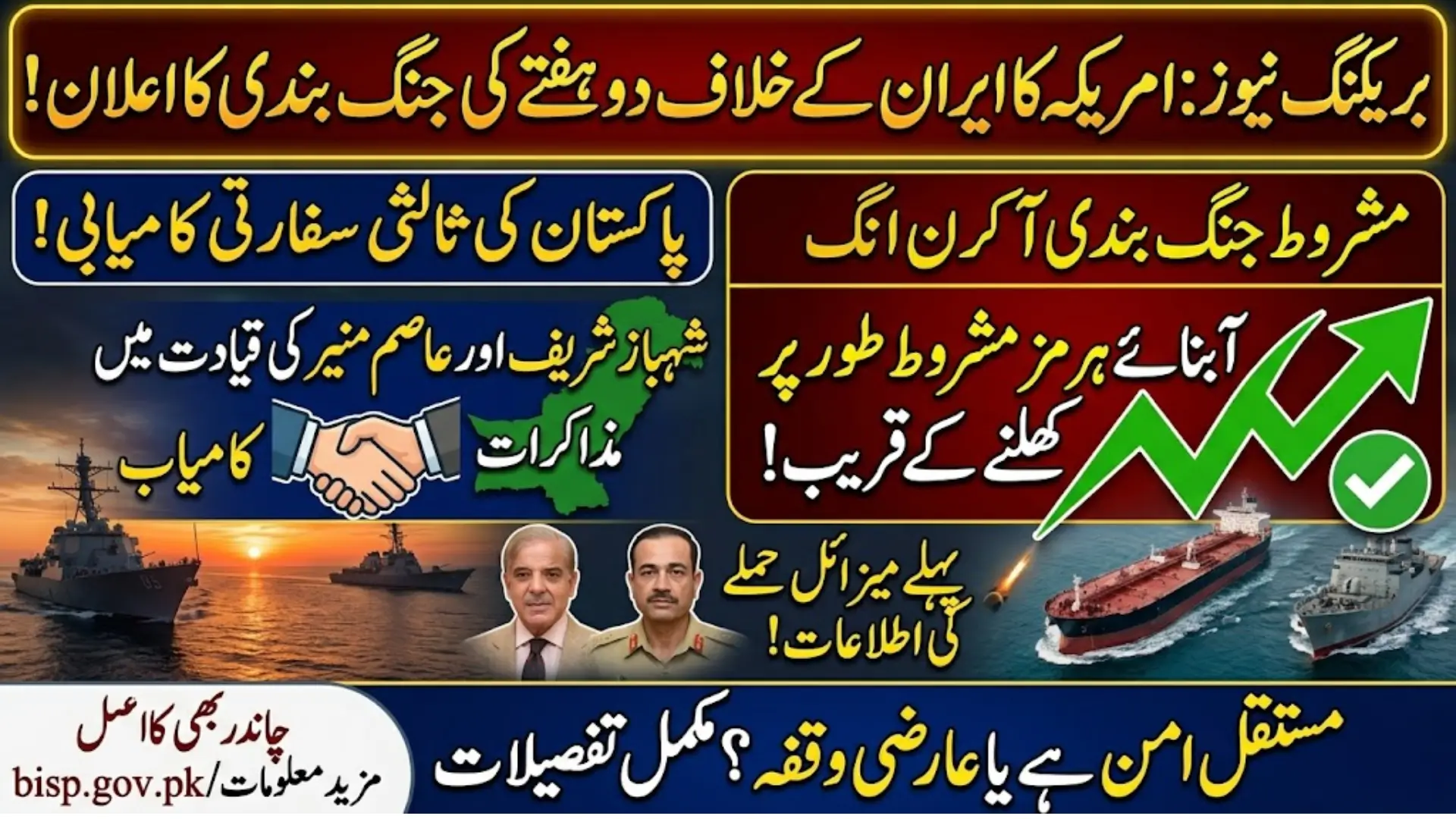
US Agrees to Two-Week Ceasefire
A major diplomatic breakthrough has emerged as Donald Trump announced that the United States has agreed to suspend bombing operations against Iran for two weeks. This decision follows intensive back-channel diplomacy led by Shehbaz Sharif and Asim Munir. The temporary ceasefire is being described as a critical opportunity to de-escalate tensions and move toward a broader peace agreement.
UK International School Qualifications in Pakistan A Gateway to Global Education
The agreement is conditional and depends on Iran’s cooperation, particularly regarding the reopening of the Strait of Hormuz. Trump called the arrangement a “double-sided” ceasefire, meaning both sides are expected to halt military actions. While the announcement has created optimism, early reports of missile activity highlight that the situation remains fragile and unpredictable.
- Ceasefire duration is initially set for two weeks
- Pakistan played a key role as a mediator
- Agreement depends on mutual compliance
- Early violations show instability in the truce
Role of Pakistan as a Key Diplomatic Mediator
Pakistan has emerged as a central player in facilitating communication between Washington and Tehran. Through direct contacts and negotiations, Islamabad helped bridge the gap between two long-standing adversaries. The involvement of Pakistan reflects its growing importance in regional diplomacy and conflict resolution.
According to reports, Pakistan conveyed proposals and conditions between both sides, ensuring that negotiations could begin on neutral ground. The upcoming talks scheduled in Islamabad further reinforce Pakistan’s position as a trusted intermediary capable of handling sensitive international disputes.
- Pakistan hosted and coordinated diplomatic exchanges
- It relayed Iran’s 10-point proposal to the US
- Islamabad will host upcoming negotiations
- Its role strengthens regional diplomatic influence
Iran’s Conditional Acceptance and Strategic Position
Iran has shown cautious willingness to participate in the ceasefire, but only under specific conditions. Abbas Araghchi stated that Iran would halt its defensive operations if all attacks against its territory stop. This reflects Iran’s strategy of maintaining strength while remaining open to negotiations.
Tehran has also agreed to allow limited and controlled passage through the Strait of Hormuz for the two-week period. However, Iranian officials emphasized that this does not signal the end of the conflict. A final agreement will depend on detailed negotiations around their proposed 10-point plan.
- Iran demands complete halt of attacks
- Strait of Hormuz access will be temporarily allowed
- Talks will not automatically end the conflict
- Military readiness remains in place
Grade VIII Examination 2026 Notification by BISE Peshawar
Importance of the Strait of Hormuz in Global Stability
The Strait of Hormuz is one of the most critical waterways in the world, handling nearly 20% of global oil shipments. Any disruption in this region directly impacts international energy markets, fuel prices, and economic stability. The ceasefire’s success heavily depends on keeping this route open and secure.
Reopening the strait is not just a political condition but also an economic necessity. Global markets have already reacted to the tensions, and a prolonged closure could trigger widespread financial consequences. This makes the current negotiations crucial for both regional peace and global economic balance.
| Factor | Impact on Global Economy |
|---|---|
| Oil Supply Disruption | Increased fuel prices worldwide |
| Shipping Delays | Trade and logistics slowdown |
| Market Uncertainty | Investor instability |
| Energy Crisis Risk | Economic pressure on importing countries |
Planned US-Iran Talks in Islamabad
Formal negotiations between the United States and Iran are set to begin in Islamabad, marking a significant step toward resolving the conflict. These talks will initially last for two weeks, with the possibility of extension if both parties agree on progress. The discussions will focus on Iran’s proposed 10-point plan.
The talks aim to address key areas of disagreement, many of which Trump claimed have already been narrowed. However, both sides remain cautious, and success will depend on mutual trust and willingness to compromise.
| Negotiation Detail | Information |
|---|---|
| Location | Islamabad, Pakistan |
| Start Date | April 11 |
| Duration | Two weeks (extendable) |
| Focus | Iran’s 10-point proposal |
- Talks will be held under diplomatic supervision
- Both sides aim to finalize a broader agreement
- Extension depends on progress
- Pakistan will facilitate the dialogue
Motorola Moto G Stylus 2026 and Moto Pad 2026 Overview
Challenges and Risks in Maintaining the Ceasefire
Despite the agreement, maintaining the ceasefire remains a major challenge. Reports of missile launches shortly after the announcement show how quickly tensions can escalate. Both sides have strong military capabilities and remain prepared for confrontation if negotiations fail.
The situation is further complicated by the involvement of other regional players. Israel’s participation in the ceasefire adds another layer of complexity, especially given its security concerns. Any violation from either side could collapse the entire process.
- Early violations threaten stability
- Multiple countries are involved in the conflict
- High mistrust between parties
- Military readiness continues on both sides
Future Outlook: فرصة for Peace or Temporary Pause
The two-week ceasefire presents a rare opportunity to move toward long-term peace. If negotiations succeed, this could lead to a comprehensive agreement that stabilizes the region and ensures secure energy routes. However, failure could result in renewed conflict with even greater intensity.
The coming days will be critical in determining whether this ceasefire becomes a turning point or just a temporary pause. Diplomatic efforts, particularly by Pakistan, will play a decisive role in shaping the outcome.
- فرصة for long-term peace agreement
- Risk of escalation if talks fail
- Pakistan’s role remains crucial
- Global attention on negotiation outcomes
Gold Prices in Pakistan Surge Sharply as Global Market Hits Record Highs
FAQs
What is the duration of the US-Iran ceasefire?
The ceasefire is set for two weeks initially, with a possibility of extension based on negotiations.
Why is Pakistan involved in this agreement?
Pakistan acted as a mediator, helping both sides communicate and agree on initial terms.
What is Iran’s 10-point proposal?
It is a framework presented by Iran for negotiations, covering key issues between both countries.
Why is the Strait of Hormuz important?
It is a major global oil route, and its closure can disrupt international energy supplies.
Will this ceasefire end the conflict permanently?
No, it is a temporary pause; a final settlement depends on successful negotiations.