
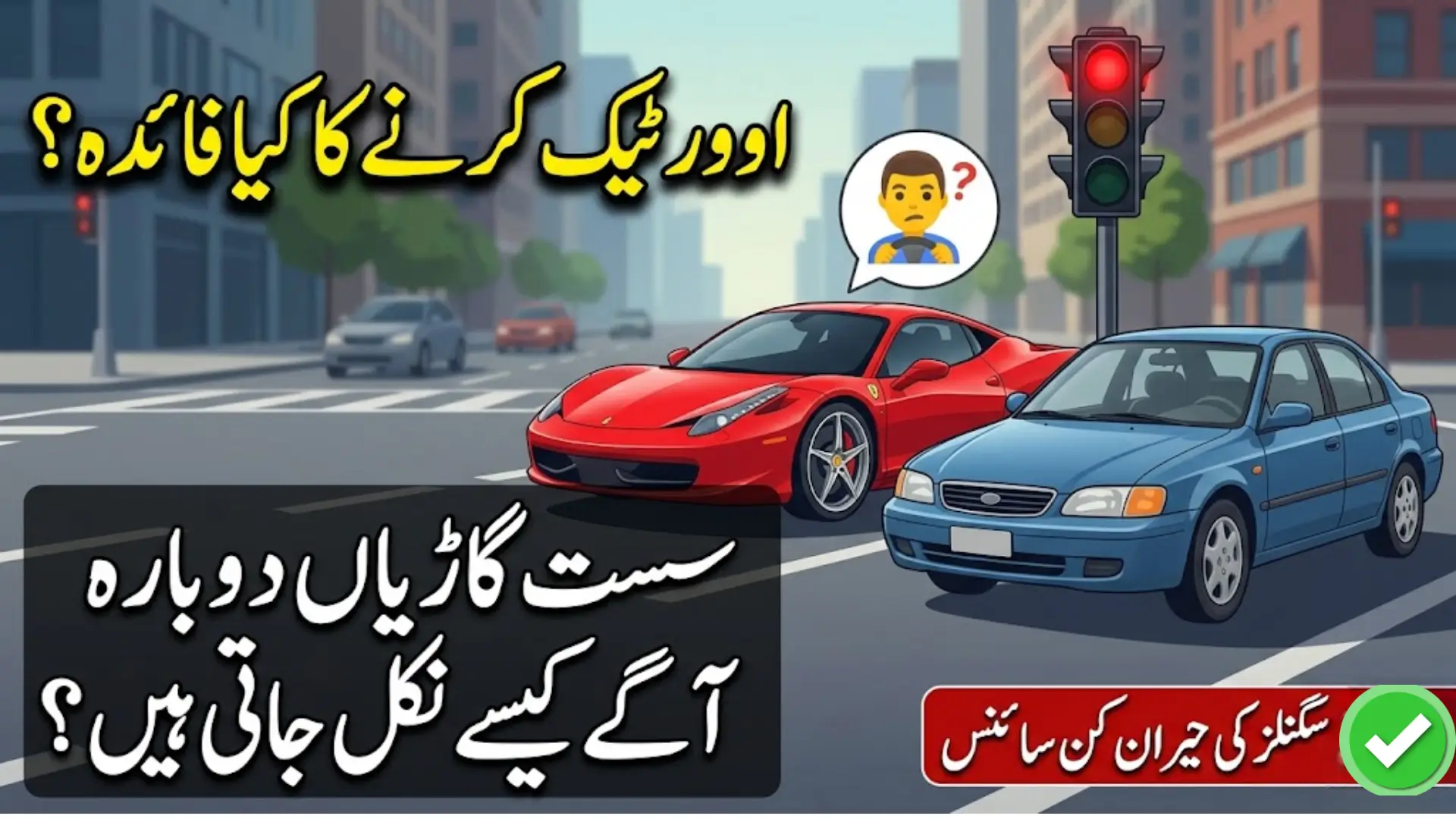
Slower Cars Catch Up After Overtaking
Many drivers have experienced a surprising situation on the road. You overtake a slower vehicle, feel confident about moving ahead, and after a short distance, the same car appears behind you again. This situation may seem strange, but it is actually quite common in urban traffic conditions.
Gold Prices in Pakistan Surge Sharply as Global Market Hits Record Highs
A recent study published in Royal Society Open Science explains this phenomenon using a simple mathematical approach. The research, led by Conor Boland from Dublin City University, shows that traffic signals are the main reason behind this unexpected outcome.
- Overtaking does not guarantee staying ahead
- Traffic lights can reset vehicle positions
- This behavior is common in city driving
US Agrees to Two-Week Ceasefire with Iran Through Pakistani Mediation
The Two-Car Model Simplified
The study uses a basic model involving two cars moving at constant but different speeds. One car is faster and overtakes the slower one. In theory, the faster car should remain ahead for the rest of the journey.
However, real-world driving includes interruptions such as traffic lights. The model assumes that signal timing is random. This means drivers cannot predict whether they will encounter a red or green light after overtaking. Because of this randomness, even a faster car can lose its advantage.
- Two cars move at fixed speeds
- Faster car gains a time lead
- Random signals disturb expected results
PTA SIM Verification Alert 2026 CNIC Expiry May Lead to SIM Block in Pakistan
How Traffic Lights Change Everything
Traffic signals play a crucial role in this situation. When the faster car reaches a red light, it must stop. During this time, the slower car continues moving and can reduce the gap between them.
If the slower car arrives at the same signal shortly after, both vehicles end up side by side again. This makes it seem like the slower car has “caught up,” even though it never increased its speed.
| Factor | Influence on Catch-Up |
|---|---|
| Time advantage | Smaller gaps increase catch-up chances |
| Signal cycle | Longer cycles create unpredictability |
| Red light duration | Longer stops help slower cars close distance |
- Red lights stop faster vehicles
- Continuous movement benefits slower cars
- Signal timing determines outcomes
Fuel Price Notification in Pakistan Declared Fake
The Concept of Random Signal Timing
One of the key ideas in the study is randomness. Traffic lights do not operate in a way that drivers can easily predict. Even if signals follow a pattern, drivers usually do not know the exact timing.
Because of this uncertainty, a driver who has just overtaken another vehicle might suddenly face a red light. At the same time, the slower car may encounter a green light and continue without stopping.
- Drivers cannot predict signal changes
- Random timing affects both vehicles
- Small delays can change positions
PTA SIM Verification Alert in Pakistan Issued for Mobile Users
Understanding the Voorhees Law of Traffic
The study introduces a concept called the Voorhees law of traffic. It is inspired by a fictional character known for always catching up, no matter how fast others move. In traffic terms, this law explains why slower cars often reappear after being overtaken.
According to this idea, when the faster car gains only a small time advantage, the chances of the slower car catching up are high. On the other hand, if the faster car creates a large gap, the probability of a catch-up becomes much lower.
- Small time advantage increases risk
- Large gaps reduce catch-up chances
- Traffic lights act as equalizers
FBR Action Against Housing Societies in Lahore
Effect of Multiple Traffic Signals
In urban areas, roads usually have several traffic lights. The study shows that as the number of signals increases, the probability of a catch-up event also rises.
Even if a faster car avoids stopping at one signal, it may be delayed at another. Over a longer route with many signals, it becomes very likely that at least one stop will allow the slower car to close the gap.
| Number of Signals | Catch-Up Probability |
|---|---|
| 1–2 signals | Low |
| 3–5 signals | Moderate |
| More than 5 | High |
- More signals increase interruptions
- Repeated stops reduce speed advantage
- Urban roads amplify this effect
Gold Rate in Pakistan Today 10 April 2026
Why This Feels So Common to Drivers
Many drivers feel that slower cars catch up more often than expected. This is because such events are easy to notice and remember. When something unexpected happens on the road, it stays in memory longer.
The study suggests that these events are statistically common, especially in cities with many traffic lights. This explains why drivers frequently experience this situation.
- Unexpected events are more memorable
- Urban driving increases frequency
- Perception matches statistical reality
GWM Pakistan Begins Local CKD Production of Tank 500
Broader Implications for Traffic Planning
This research is not only useful for explaining driver experiences. It also has practical applications in traffic management and urban planning. By understanding how signals affect vehicle movement, planners can design better traffic systems.
Improved signal timing and smarter traffic models can help reduce congestion and make travel more efficient. The study highlights that speed alone is not enough to determine travel time.
- Traffic models should include signal behavior
- Better timing can reduce congestion
- Efficient systems improve travel flow
Kia Sorento Hybrid Installment Plan in Pakistan
Conclusion
The idea that a slower car can catch up after being overtaken may seem surprising, but it is backed by scientific research. Traffic signals, random timing, and small time differences all contribute to this outcome.
This study provides a clear explanation for a common driving experience. It shows that road dynamics are more complex than they appear and that factors like timing and probability play a major role in everyday traffic situations.
- Overtaking advantage is not always permanent
- Traffic signals control vehicle flow
- Real-world driving depends on multiple factors