
Pakistan Commerce Ministry Prepares
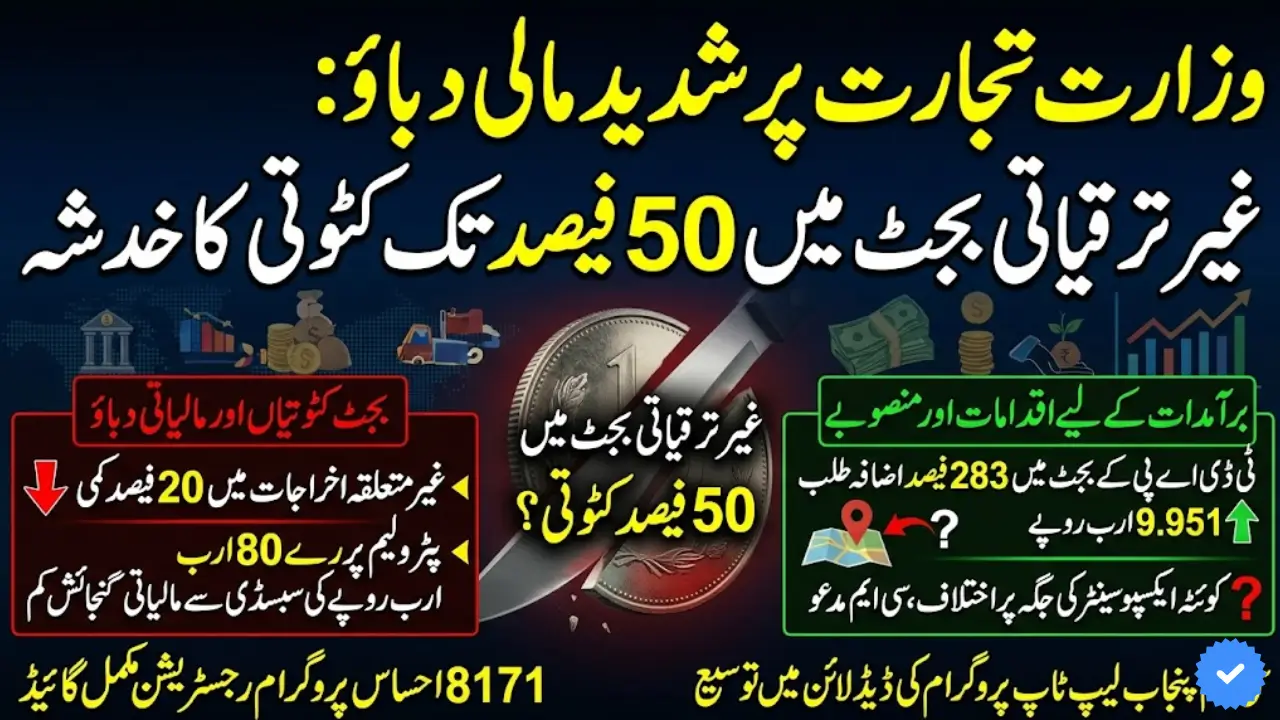
Pakistan’s Ministry of Commerce is preparing to manage its operations under significant financial constraints as the government faces increasing fiscal pressure. Officials have indicated that the ministry can continue functioning even if its non-development budget is reduced by up to 50 percent in the upcoming fiscal year 2026-27. This move reflects broader economic challenges, including global uncertainties and regional geopolitical tensions affecting financial planning.
Sharp Surge in Gold Prices in Pakistan Driven by
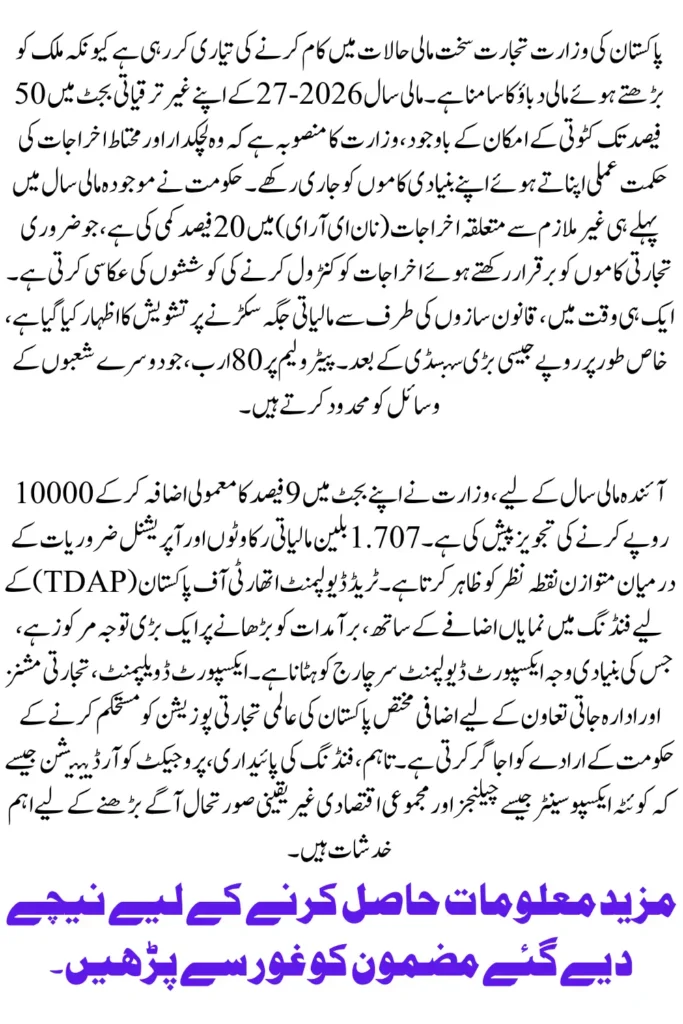
The government has already started tightening expenditures during the current fiscal year 2025-26 by reducing non-Employee Related Expenditure (non-ERE) by 20 percent in the final quarter. These measures highlight the state’s effort to control spending while maintaining essential services and trade-related functions.
- Non-ERE budget reduced by 20 percent in FY2025-26
- Possible 50 percent cut expected in FY2026-27
- Fiscal pressure linked to Middle East developments
- Focus on maintaining core operations despite cuts
Senate Committee Concerns Over Shrinking Fiscal Space
During a Senate Standing Committee meeting on Commerce, concerns were raised about Pakistan’s limited fiscal capacity. Senator Saleem Mandviwala pointed out that recent subsidies, including Rs. 80 billion on petroleum products, have further strained the national budget. These expenditures reduce the government’s ability to allocate funds to other sectors.
Lawmakers emphasized that Pakistan’s fragile financial condition may create difficulties in accommodating future budget demands. The discussion highlighted the need for careful financial planning to balance subsidies, development, and operational expenses without worsening the economic situation.
- Rs. 80 billion spent on petroleum subsidy
- Concerns over limited fiscal space
- Pressure on future budget allocations
- Need for balanced financial strategy
Ministry’s Budget Strategy for FY2026-27
The Ministry of Commerce has proposed a cautious budget plan for the next fiscal year. Despite the possibility of major cuts, the ministry has requested only a 9 percent increase in its allocation, showing a restrained approach to spending. The total proposed budget stands at Rs. 1.707 billion, compared to Rs. 1.562 billion in FY2025-26.
Officials have stated that the ministry will adjust its expenditure plans according to available resources. This flexible approach aims to ensure continuity of trade-related activities while adapting to financial limitations.
| Fiscal Year | Proposed Budget | Increase |
|---|---|---|
| 2025-26 | Rs. 1.562 billion | — |
| 2026-27 | Rs. 1.707 billion | 9% |
- Modest 9 percent budget increase proposed
- Flexible expenditure planning strategy
- Focus on essential operations
- Adjustment based on fiscal availability
CM Punjab Laptop Program Deadline Extended 2026
Significant Increase in TDAP Funding Proposal
A major highlight of the budget proposal is the sharp increase requested for the Trade Development Authority of Pakistan (TDAP). The ministry has sought Rs. 9.951 billion for FY2026-27, which is a 283 percent increase compared to the current allocation of Rs. 2.6 billion.
This increase is mainly due to the removal of the Export Development Surcharge (EDS), which previously supported export-related activities. Without this surcharge, the government needs to provide additional funding to maintain export competitiveness in global markets.
- TDAP budget increased by 283 percent
- New allocation proposed at Rs. 9.951 billion
- Previous allocation was Rs. 2.6 billion
- Increase due to removal of EDS
Utilization of Current TDAP Funds
The current fiscal year’s TDAP budget has already been largely utilized, reflecting active engagement in trade promotion activities. By March 2026, Rs. 1.811 billion had been released, and nearly 90 percent of that amount was spent by March 21.
This high utilization rate indicates strong demand for export promotion initiatives. However, it also raises concerns about whether such high funding levels can be sustained under tight fiscal conditions.
- Rs. 1.811 billion released by March 2026
- Around 90 percent funds already utilized
- High demand for export promotion
- Concerns over future funding sustainability
Budget Allocations for Attached Departments
The Ministry of Commerce has also proposed budgets for its affiliated organizations to ensure smooth functioning across different areas of trade and development. These allocations aim to strengthen institutional capacity and support policy implementation.
The proposed funding covers training institutes, regulatory bodies, and dispute resolution organizations, all of which play a key role in Pakistan’s trade ecosystem.
| Organization | Proposed Allocation |
|---|---|
| PITAD | Rs. 248 million |
| DGTO | Rs. 142 million |
| TDRO | Rs. 415.5 million |
| NTC | Rs. 914 million |
- Focus on strengthening trade institutions
- Support for training and development
- Funding for dispute resolution mechanisms
- Improved regulatory oversight
8171 Ehsaas Program Registration 2026 Complete
Export Development and Trade Support Initiatives
In addition to departmental budgets, significant funds have been proposed for export-related schemes and international trade efforts. These initiatives aim to boost exports and improve Pakistan’s position in global markets.
The government plans to allocate Rs. 20 billion under the Export Development Fund (EDF), along with additional funds for export rebate schemes and trade missions abroad.
- Rs. 20 billion proposed for EDF
- Rs. 12.158 billion for DLTL and TUFF schemes
- Rs. 7.427 billion for trade missions abroad
- Focus on enhancing export competitiveness
Committee Recommendations and Expo Centre Project
The Senate committee approved most of the ministry’s budget proposals while suggesting improvements in planning and execution. It recommended that TDAP submit its annual business plan to align funding with available resources and ensure transparency.
The committee also approved Rs. 4.83 billion for the Quetta Expo Centre project, but with conditions regarding relocation. Lawmakers stressed the importance of selecting a suitable site and resolving disagreements with provincial authorities.
- Approval of Rs. 4.83 billion for Expo Centre
- Recommendation for project relocation
- Emphasis on proper planning
- Coordination with provincial government
Challenges in Project Implementation and Coordination
The proposed Expo Centre project in Quetta has faced disagreements over its location, with lawmakers from Balochistan opposing the current site. The committee has invited the chief minister to resolve the issue through discussion.
There is also a suggestion to use land available with the National Disaster Management Authority (NDMA), although concerns have been raised about joint management. These challenges highlight the need for better coordination between federal and provincial authorities.
- Dispute over project location
- Invitation to chief minister for discussion
- Proposal to use NDMA land
- Need for improved coordination
BISP Kafalat Biometric Verification Problems Cause
FAQs
What budget cut is the Ministry of Commerce expecting?
The ministry is prepared to operate even if its non-development budget is reduced by up to 50 percent in FY2026-27.
Why is TDAP requesting a large budget increase?
The increase is due to the removal of the Export Development Surcharge, requiring more government funding for export support.
What concerns did the Senate committee raise?
The committee highlighted shrinking fiscal space and the impact of subsidies on the national budget.
What is the total proposed budget for FY2026-27?
The Ministry of Commerce has proposed a budget of Rs. 1.707 billion for the next fiscal year.
What is the status of the Quetta Expo Centre project?
The project is approved but may be relocated due to concerns raised by lawmakers from Balochistan.