
Complete BISP Guide for Women 2026
The Benazir Income Support Programme (BISP) remains Pakistan’s largest social protection initiative, designed to provide financial aid to low-income and vulnerable women. As the year 2026 begins, the government has continued the quarterly payment of 13,500 rupees for eligible women across the country. This support helps families manage essential needs such as food, healthcare, and children’s education. However, many women still face challenges during registration, verification, or payment collection. This article provides a complete 1000-word guide explaining payment updates, eligibility, verification steps, and how to fix common issues in 2026
You Can Also Read:BISP Next Installment Date 2026 in Pakistan
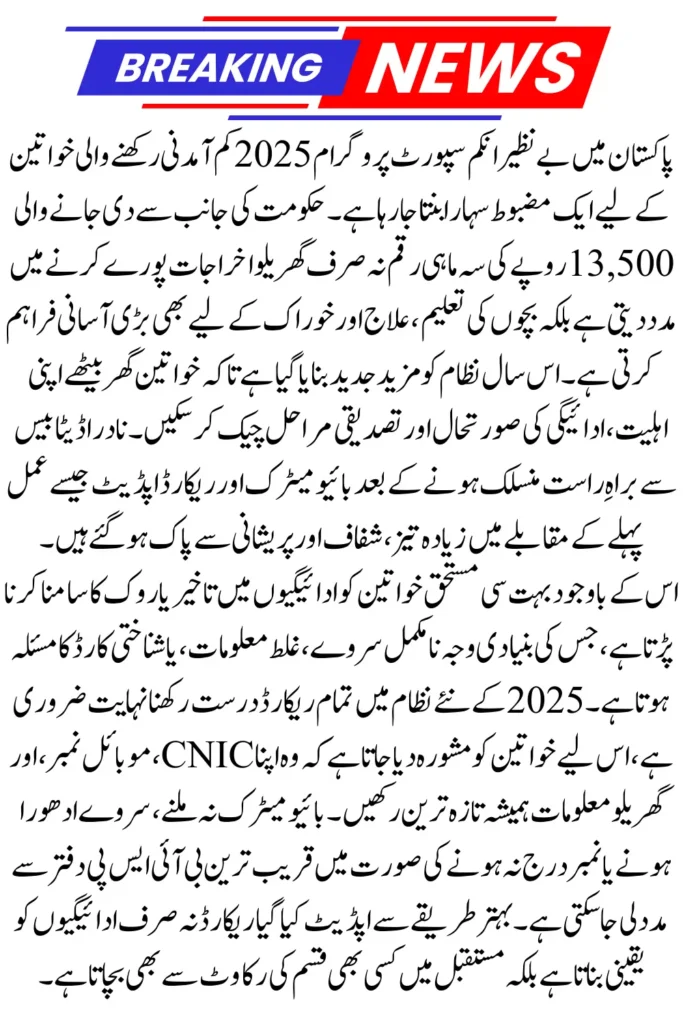
BISP aims to empower women by making them the primary recipients of the assistance. Every eligible household must have a female CNIC holder because the programme directly transfers payments under her name. For many beneficiaries, the first challenge is ensuring their records are correct and updated. BISP 2026heavily relies on the updated National Socio-Economic Registry (NSER), meaning that if any information is incomplete or outdated, payments may be delayed or stopped. Therefore, understanding how the programme works and what steps to take when issues appear is essential.
BISP 2026 Payment Update
In 2026, BISP is distributing the quarterly payment of 13,500 rupees in phases across all districts. Women who have completed their dynamic survey and passed their biometric verification receive their installments on time. Payment messages are sent from the official code 8171, informing beneficiaries about the release of funds. Women who do not receive SMS alerts can still check their eligibility through the 8171 portal or by visiting a nearby BISP office. It is important to note that payments are issued only after the system confirms that all beneficiary records are correct and active.
Eligibility Requirements for 2026
To qualify for the BISP 13,500 rupees quarterly assistance in 2026, applicants must meet several conditions. The beneficiary must be a woman with a valid CNIC registered in her name. The household must fall within the low-income category and meet the poverty threshold determined during the NSER survey. Families with high income, large property, vehicles, or government employment are usually marked ineligible. Additionally, beneficiaries must not be drawing other government salaries or pensions.
The NSER survey plays a key role in determining eligibility. Every family’s income, expenses, assets, and household conditions are evaluated. If the survey shows that the applicant meets the criteria, she is included in the programme. If the survey information is outdated or missing, the system temporarily withholds payments until the data is updated again.
You Can Also Read:8171 Ehsaas Program Payment Issues – Common
How to Check Your Payment Status
Women can use several methods to verify their BISP payment status in 2026. The easiest method is the official SMS service. You simply type your 13-digit CNIC number and send it to 8171. Within seconds, you receive details of whether you are eligible, under verification, or not registered.
Another way is the 8171 web portal. By entering your CNIC and the required code, you can view your complete status, including eligibility, survey results, and payment details. This method is useful for those with internet access. For women who prefer personal assistance, visiting the nearest BISP tehsil office is the best option. Staff can check your status, guide you through corrections, and help complete any pending processes.
How Payments Are Collected
Once eligibility is confirmed, beneficiaries can collect their 13,500 rupees payment from designated payment centres, partner bank branches, or biometric camps. A fingerprint verification process is used to ensure the correct person receives the funds. This step is essential because the entire system is designed around secure biometric identification. Women should always bring their original CNIC when collecting their payment. In some areas, payments are also issued through digital banking partners, making withdrawal faster and more convenient.
Common Registration and Verification Issues
Many women face issues that prevent their payments from being issued on time. The most common problem is an expired or incorrect CNIC. If the CNIC does not match BISP records, payments are blocked. The solution is to visit NADRA, update the CNIC, and then verify it at the BISP office.
Another common issue is an incomplete NSER survey. Without an updated survey, the system does not confirm eligibility. The solution is to complete the dynamic survey at the nearest BISP centre. Biometric failures also occur when fingerprints do not match. In such cases, a beneficiary can request a biometric update or override at a BISP office.
Many women do not receive SMS updates because their mobile number is not registered under their CNIC. Updating the mobile number at a BISP or NADRA centre resolves this issue. Some beneficiaries were previously marked ineligible due to old data but can now reapply after updating their information.
Important Tips Before Visiting a BISP Office
Women should always bring their original CNIC, along with any supporting documents like utility bills or household information. It is important to know the mobile number registered against the CNIC and to ensure all family details are correct. Always request a receipt or confirmation after updating information to avoid future confusion.
You Can Also Read:Punjab T-Cash Card Student Application: Required
Safety Precautions
BISP never sends messages from any number other than 8171. Women should avoid sharing personal information with unknown callers or unofficial websites. Registration and verification at BISP centres are completely free of cost, and no representative is allowed to charge money for assistance. Staying alert to fraud is crucial to protect your financial benefits.
FAQs
1. How long does it take to receive the 13,500 rupees payment after completing registration?
Once your survey and biometric verification are completed, the system reviews your status. If found eligible, you receive an SMS from 8171 when your payment is ready.
2. What does under verification mean when checking through 8171?
It means your information is still being reviewed. You may need to wait a few days or visit a BISP office if it continues for too long.
3. Can someone else collect the BISP payment for me?
No. Only the female beneficiary whose CNIC is registered can collect the payment through biometric verification.
4. What if the 8171 web portal does not show my details?
You can use the 8171 SMS service or visit your nearest BISP office for assistance.
5. Can I apply again if I was rejected before?
Yes. In 2026, previously ineligible applicants can update their records, complete the dynamic survey, and request re-evaluation
Conclusion
BISP Payment Tracking 2026 has made the entire process of receiving financial assistance much easier, faster, and more transparent for low-income families. With the upgraded digital system, beneficiaries can now check their payment status, verify eligibility, and update their information without needing to visit offices. The integration with NADRA, improved SMS service, and the introduction of the digital wallet have all contributed to a smoother experience.
As Pakistan continues to modernize its welfare programs, these advancements ensure that deserving households receive timely support with greater accuracy and convenience. By using the updated tracking tools regularly, beneficiaries can avoid delays and stay informed about every step of their payment process.