
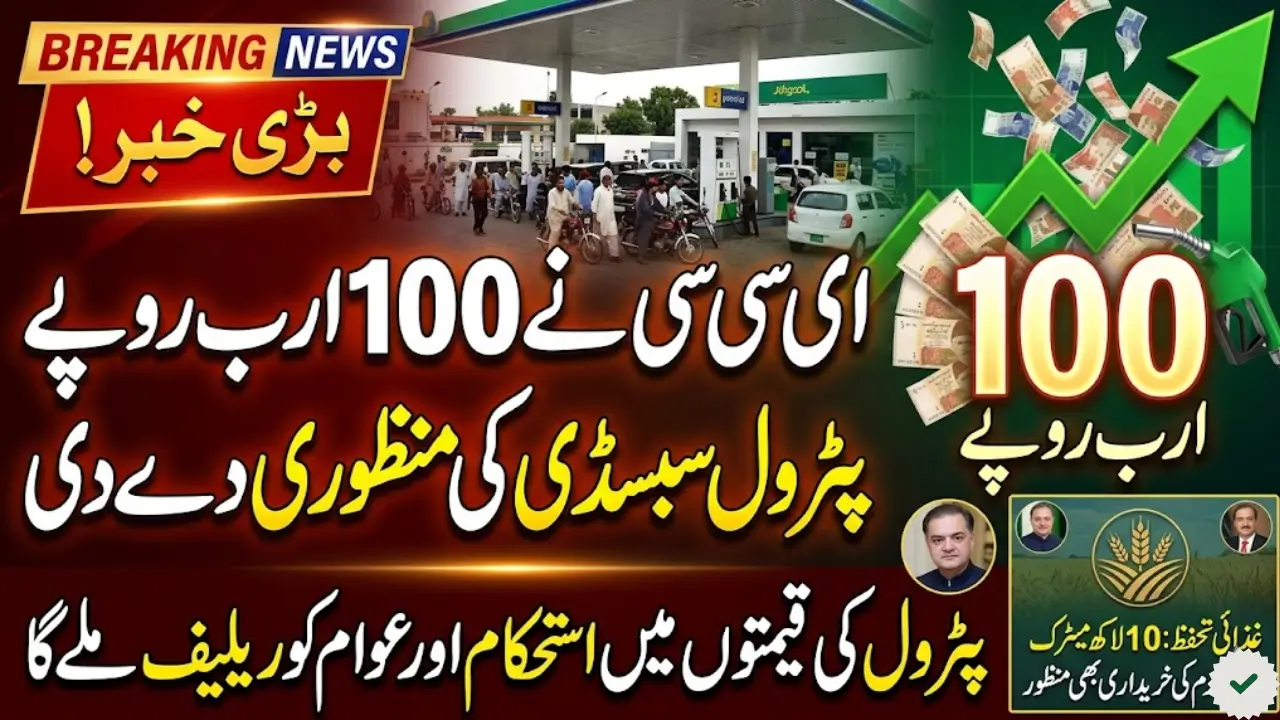
ECC Approves Rs. 100 Billion
The Economic Coordination Committee (ECC) has approved a Rs. 100 billion Technical Supplementary Grant aimed at maintaining stability in petroleum prices across Pakistan. This step comes at a time when global oil markets are experiencing uncertainty due to geopolitical tensions, especially in the Gulf region. The initiative is part of the government’s broader effort to protect consumers from sudden increases in fuel costs that directly impact daily living expenses.
Government Petrol Subsidy 2026 New App Based
The grant will be directed to the Prime Minister’s Austerity Fund, which is designed to absorb financial shocks caused by international price fluctuations. By using this fund, the government aims to avoid passing the burden of rising fuel prices onto the public. This move is expected to provide temporary relief and ensure smoother economic conditions for both households and businesses.
- Rs. 100 billion allocated as a supplementary grant
- Funds will stabilize fuel prices in local markets
- Focus on protecting consumers from global volatility
PTA Plans Separate 5G Spectrum Auction for Azad
Funding Strategy Through PSDP Adjustments
To arrange the required funds, the ECC has decided to utilize resources from the Public Sector Development Program (PSDP). This will be done through a process of rationalization and voluntary surrender of funds by various ministries. The approach ensures that critical development projects continue without major disruptions while still freeing up necessary financial resources.
Officials emphasized that this reallocation is carefully planned to minimize any negative impact on ongoing infrastructure and development initiatives. By prioritizing essential projects and temporarily adjusting less urgent expenditures, the government aims to balance economic stability with development goals.
- Funds sourced from PSDP reallocations
- Ministries will surrender non-essential allocations
- Minimal disruption to ongoing development projects
| Funding Source | Strategy Used | Expected Impact |
|---|---|---|
| PSDP Funds | Rationalization & surrender | Maintains development balance |
| Austerity Fund | Direct allocation | Stabilizes fuel prices |
Impact of Global Oil Market Developments
The ECC’s decision is closely linked to recent developments in international oil markets, particularly in the Gulf region. Fluctuations in crude oil prices can have a direct effect on Pakistan’s import costs, leading to increased fuel prices domestically. By taking proactive measures, the government aims to cushion the economy against sudden shocks.
Global uncertainties, including geopolitical tensions and supply chain disruptions, make it difficult to predict oil prices. Therefore, this financial buffer allows the government to respond quickly and maintain price stability. It also supports economic planning by reducing uncertainty for businesses that depend heavily on fuel.
- Global oil prices remain unpredictable
- Gulf region tensions affecting supply chains
- Government aims to reduce economic uncertainty
Wheat Procurement Plan Under INWP 2025-26
In addition to the petroleum-related decision, the ECC approved the procurement of up to 1 million metric tons of wheat under the Interim National Wheat Policy (INWP) 2025-26. This step is aimed at strengthening the country’s strategic reserves and ensuring food security in the coming months.
The wheat will be purchased through a transparent and competitive process involving the private sector. This method is expected to improve efficiency, reduce costs, and maintain fairness in procurement. Authorities also highlighted that the plan is flexible and can be adjusted based on crop yields, market conditions, and storage capacity.
- Up to 1 million metric tons of wheat to be procured
- Private sector involvement ensures transparency
- Flexible policy based on real-time conditions
| Policy Element | Details | Purpose |
|---|---|---|
| Procurement Volume | 1 million metric tons | Strengthen reserves |
| Process | Competitive private-sector bidding | Ensure transparency |
| Flexibility | Adjustable based on conditions | Maintain market stability |
Key Participants and Decision-Making Process
The ECC meeting was chaired by Senator Muhammad Aurangzeb and included participation from several key federal ministers and officials. Some members attended virtually, reflecting a hybrid decision-making approach that ensures inclusivity and efficiency in governance.
Senior officials from various ministries contributed to discussions, providing insights into economic trends and sector-specific challenges. Their input played a crucial role in shaping decisions related to both petroleum price stabilization and wheat procurement strategies.
- Meeting chaired by Senator Muhammad Aurangzeb
- Participation from federal ministers and secretaries
- Hybrid format with virtual attendance
BISP 8171 Payment Card Launched Easier
FAQs
What is the purpose of the Rs. 100 billion grant?
The grant is meant to stabilize petroleum prices and protect consumers from global oil price fluctuations. It helps reduce the financial burden on the public.
How will the government arrange these funds?
Funds will be sourced from PSDP allocations through rationalization and surrender by ministries, ensuring minimal impact on development projects.
Why is petroleum price stability important?
Stable fuel prices help control inflation and reduce costs for transportation, businesses, and households.
What is the wheat procurement plan about?
The government will purchase up to 1 million metric tons of wheat to strengthen reserves and maintain market stability.
Will development projects be affected by this decision?
The government has stated that only non-essential funds will be reallocated, so major development projects should continue without disruption.
BISP 8171 Missed Payment in 2026 How to Claim